Free Government iPhone in Florida: Lifeline Options, EBT, Medicaid, and Safe Steps for 2026
Florida residents often search for a free government iPhone because they need a reliable phone for work, school, health care, benefits, family safety, hurricane alerts, and everyday communication. The real answer is more careful: Lifeline is active, ACP has ended, and iPhone offers depend on the provider, ZIP code, stock, device condition, and program rules.
Quick answer: There is no verified official statewide Florida program that guarantees a free iPhone to every eligible resident. However, eligible Florida households may be able to reduce phone or internet service costs through Lifeline, and some participating companies may offer a free or discounted smartphone. SNAP, EBT, Medicaid, SSI, income eligibility, housing assistance, veterans benefits, or Tribal eligibility can help prove Lifeline eligibility, but they do not guarantee an iPhone.
Lifeline Free iPhone is independent and informational only. This page does not collect applications, SSNs, EBT PINs, banking details, or card numbers.
Provider lists can differ between Miami, Jacksonville, Tampa, Orlando, rural Panhandle counties, the Keys, and inland communities.
Florida Page Navigation
Use this page to understand what is realistic, what is official, and how to check safely before choosing a Lifeline provider.
Quick Answer for Florida Residents
Lifeline is active, ACP is not
Lifeline still helps eligible households reduce the cost of phone, internet, or bundled service. The Affordable Connectivity Program ended because no additional funding was provided, and households stopped receiving ACP discounts after June 1, 2024.
iPhones are not guaranteed
Florida residents may see phone offers from Lifeline-related providers, but an iPhone depends on provider rules, ZIP code, stock, shipping, device condition, activation, and any required copay. Android phones are often more common.
Florida reality check: EBT/SNAP or Medicaid can help prove eligibility for Lifeline. They do not automatically create a free iPhone benefit. Always check the official Lifeline route and compare provider terms before applying.
What “Free Government iPhone” Means in 2026
The phrase “free government iPhone in Florida” can be confusing because most people use it to describe several different things at once: Lifeline eligibility, provider phone promotions, refurbished device offers, low-income phone service, and ZIP-code-based availability. The federal government does not run a program that promises every eligible person a new iPhone.
Lifeline is mainly a service discount. It can help reduce the monthly cost of phone, internet, or bundled service for eligible households. A phone offer, if one is available, is usually controlled by the participating provider. That means the provider decides whether the device is an Android phone, a basic smartphone, a refurbished iPhone, a discounted iPhone, or no device at all.
In Florida, this distinction matters because provider availability can change from one ZIP code to another. A household in Orlando may see different options than a household in the Florida Keys. A resident in rural North Florida may have fewer wireless choices than someone in Miami-Dade or Broward County. A senior in a manufactured-home community may need different document help than a student in Gainesville or Tallahassee.
Service discount
Lifeline helps lower eligible phone, internet, or bundled service costs. The service benefit is the core program.
Device offer
A phone may be offered by a provider, but device type, stock, fees, and condition are provider-specific.
Safe expectation
Expect Android phones to be more common. Treat any guaranteed iPhone claim as something to verify before sharing information.
Does Florida Have a Free iPhone Program?
There is no verified official statewide program in Florida that guarantees a free iPhone to every eligible resident. Florida benefit programs such as Food Assistance through SNAP and Florida Medicaid may help a resident prove Lifeline eligibility, but they are not iPhone distribution programs.
The safer path is to treat “government iPhone program Florida” as a search for Lifeline-related phone options, not as a promise. Residents can check eligibility, gather documents, search providers by ZIP code, compare device terms, and then decide whether a provider offer is worth applying for.
Local support can still matter. Florida residents who do not see a strong phone offer can use public libraries, community action resources, broadband access resources, and assistive technology programs while they compare phone or internet choices.
Important: Do not trust a website or social media seller that says Florida has a guaranteed official iPhone program, asks for your EBT PIN, or claims ACP is still paying new discounts after June 1, 2024.
Main Ways Florida Residents May Qualify
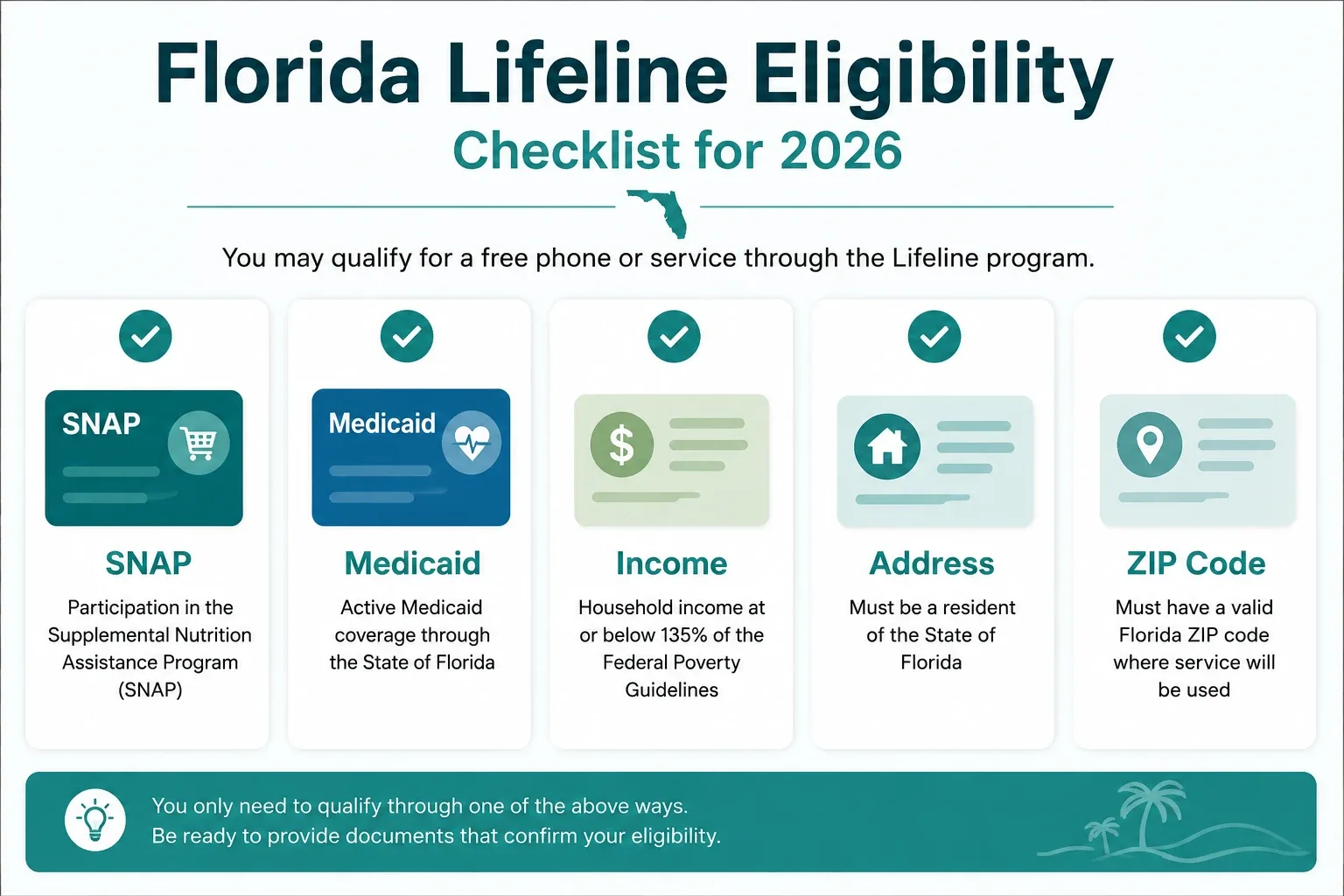
Florida residents commonly qualify for Lifeline through a qualifying public benefit program or by household income. The exact check may happen through the National Verifier, Lifeline Support, or a participating provider. If automatic verification fails, you may need to upload or submit documents.
| Eligibility path | Florida example | What it may prove | Phone expectation |
|---|---|---|---|
| SNAP / Food Assistance | Florida Food Assistance through SNAP, managed through DCF and MyACCESS | Can help prove Lifeline program eligibility | Does not guarantee an iPhone |
| Medicaid | Florida Medicaid, with AHCA administration and DCF eligibility handling for many applicants | Can help prove Lifeline program eligibility | Provider stock and ZIP code still decide device options |
| SSI | Supplemental Security Income recipients, including many seniors and people with disabilities | Qualifying program route | May still receive Android or service-only offer |
| Income | Household income at or below 135% of Federal Poverty Guidelines | Income-based Lifeline qualification | Documents may be required if databases cannot confirm income |
| Housing assistance | FPHA or Section 8 where accepted for Lifeline | Program participation proof | Household rule still applies |
| Veterans and survivors | Veterans Pension or Survivors Benefit | Qualifying program route | Check provider terms carefully |
| Tribal programs | Residents on qualifying Tribal lands, including relevant Seminole or Miccosukee areas where applicable | May qualify through Tribal eligibility rules | Enhanced Lifeline rules may apply, but device offers are still not guaranteed |
EBT and SNAP Free iPhone Options in Florida
Florida’s SNAP benefit is commonly called Food Assistance. It is administered by the Florida Department of Children and Families through the Office of Economic Self-Sufficiency, and many residents manage benefits through MyACCESS. If you receive Florida Food Assistance, that can help prove Lifeline eligibility.
That does not mean an EBT card automatically gives you a free iPhone. A provider may still need to confirm your eligibility, check your ZIP code, review your household status, and explain the device terms. Some providers may show Android phones, 5G smartphones, refurbished devices, discounted iPhones, or no phone offer in a particular area.
Common Florida SNAP document issues include an old MyACCESS address, a notice that shows a case number but not the applicant’s name, a screenshot that does not show active benefit status, or a mismatch between a legal name and a nickname. If you apply through a provider, keep your EBT PIN private. A legitimate phone eligibility check should not require your EBT PIN.
For more EBT-specific help, read the plain-English page on free iPhone with EBT. Use it to understand what EBT can prove, what it cannot promise, and how to avoid fake approval claims.
Medicaid Free iPhone Options in Florida
Florida Medicaid can also help prove Lifeline eligibility. Florida Medicaid services are administered by the Agency for Health Care Administration, commonly called AHCA. For many applicants, Medicaid eligibility is handled through the Florida Department of Children and Families, while some SSI-related cases may be handled through Social Security.
If Medicaid is your eligibility route, the verifier or provider may ask for a benefits letter, approval notice, current account screenshot, or another accepted document that shows your name and active benefit. The exact document request can vary based on whether your information can be confirmed electronically.
Medicaid does not guarantee an iPhone. A provider still controls phone type, stock, activation requirements, shipping, monthly plan details, and any required copay. If a provider advertises an iPhone, check whether it is refurbished, whether it needs a paid upgrade, and whether the plan works well where you live.
Lifeline iPhone and Free Phone Options in Florida
Lifeline is overseen by the FCC and administered by USAC. In most states, including Florida, residents use the National Verifier or Lifeline Support path to confirm eligibility. After approval, the resident usually chooses a participating phone or internet company. That company manages the service, device, bill, activation, and customer support.
The USAC Companies Near Me tool can help Florida residents search Lifeline companies by ZIP code, city, and state. This is important because Florida is large and varied. A provider that appears around Tampa Bay may not show the same device offer in the Panhandle, the Keys, or inland agricultural counties.
The household rule is also important. Lifeline is generally limited to one benefit per household, not one benefit per person. If multiple adults live at the same address, the verifier may need to know whether they share income and expenses.
What Lifeline can help with
- Monthly phone service discount
- Internet or bundled service discount where available
- Connection to participating companies
- Eligibility through benefits or income
What Lifeline does not promise
- A new iPhone for every eligible resident
- Same-day approval or shipping
- Provider availability in every ZIP code
- No-fee device upgrades
To compare general provider expectations, visit the Lifeline phone providers page before choosing a company.
Phone and Internet Access Issues Across Florida
Florida residents in Jacksonville, Miami, Tampa, Orlando, St. Petersburg, Hialeah, Port St. Lucie, Cape Coral, Tallahassee, Fort Lauderdale, Gainesville, Pensacola, Naples, and smaller communities may see different provider options because Lifeline availability is checked by ZIP code.
Metro areas such as Miami-Dade, Broward, Tampa Bay, Orlando, and Jacksonville may show more provider choices, but more choices do not mean an iPhone is guaranteed. Rural areas in the Panhandle, Big Bend, inland agricultural counties, the Everglades region, and parts of the Florida Keys may face different wireless coverage, fewer local provider options, or shipping limits.
Florida also has practical document issues that can affect applications. Hurricane displacement, seasonal housing, mobile home communities, PO Box use, shared family addresses, and address changes in MyACCESS can cause mismatches. Before applying, make sure your legal name, address, and benefit documents match as closely as possible.
The FloridaCommerce Office of Broadband focuses on broadband availability and effectiveness, especially in small and rural communities. Florida’s Division of Library and Information Services supports public libraries, and the Florida Electronic Library can help residents access research, career, health, and reference resources. For people with disabilities, FAAST provides assistive technology reuse and financing resources that may help with access needs beyond a phone plan.
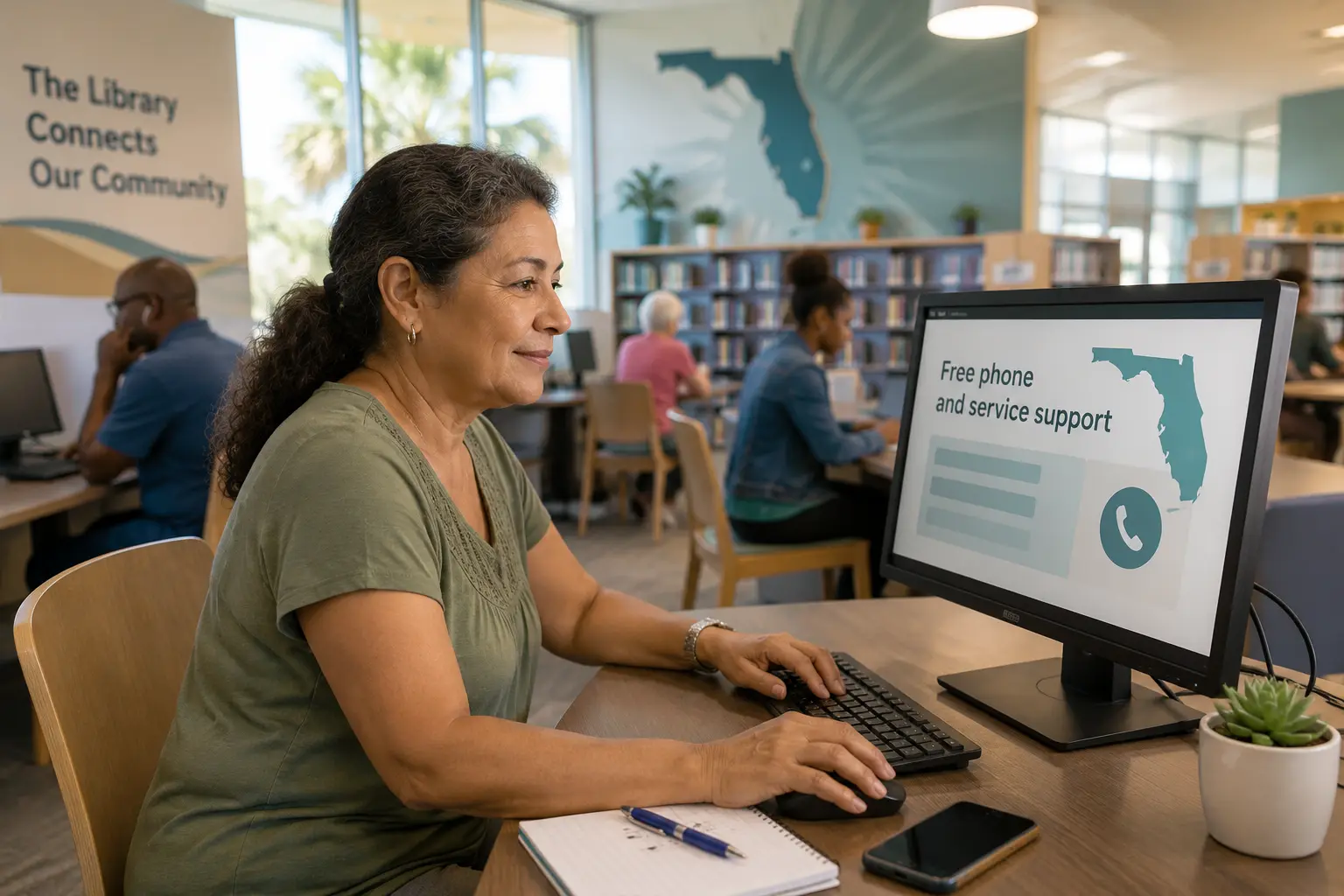
Safe Path to Check Lifeline iPhone Options in Florida
Use this visual path before sharing information with any provider or website.
Documents You May Need
Many Florida residents are approved through automatic checks, but not everyone. If your benefit, income, identity, or address cannot be confirmed, you may need documents. The best document is usually current, readable, and shows the same legal name you used on the application.
| Document type | Examples | Florida-specific issue to check |
|---|---|---|
| Identity | State ID, driver license, passport, or other accepted proof | Name should match benefit documents, including suffixes and hyphenated names |
| Address | Utility bill, lease, mortgage statement, official letter, or accepted proof | Seasonal address, hurricane displacement, PO Box, or mobile home lot records may need extra care |
| Benefit proof | SNAP notice, Medicaid approval letter, SSI letter, housing assistance letter | MyACCESS screenshots should show name and active benefit if accepted |
| Income proof | Tax return, pay stubs, unemployment benefits, pension or retirement statement | Use consecutive and current documents if income cannot be verified |
| Household worksheet | Lifeline Household Worksheet when another adult at the same address has Lifeline | Important for shared family homes, roommates, and multi-unit housing |
| Tribal documents | Accepted Tribal program or Tribal identification documents where relevant | May apply for residents on qualifying Tribal lands |
For a step-by-step document and application overview, use the how to apply for a Lifeline phone page.
Apply Now in Florida: Safe Eligibility and Provider Check
This is not a government form and this site does not collect sensitive information. Use this section as a safe pre-check before you visit an official Lifeline route or a participating provider.
Eligibility pre-check
Check whether you qualify through Florida Food Assistance, Medicaid, SSI, income, housing assistance, veterans benefits, or Tribal eligibility.
Document readiness
Make sure your legal name, current Florida address, and benefit documents match before you apply.
ZIP code provider check
Search by your Florida ZIP code because provider availability can vary even inside the same metro area.
Device expectation
Look for iPhone terms, Android backup options, refurbished status, 5G support, activation, shipping, and copay details.
Do not enter your SSN, EBT card number, EBT PIN, bank details, card details, date of birth, phone number, or home address on this page. Approval and iPhone stock are never guaranteed.
Provider Availability and ZIP Code Checks in Florida
Florida is not a single phone market. A household in West Palm Beach may see a different provider list than a household in Tallahassee, Ocala, Fort Myers, Lakeland, or Key West. Even within one county, device offers can differ based on network coverage, company participation, and address validation.
Before applying, compare the monthly service, data allowance, hotspot rules if offered, activation cost, shipping cost, copay, phone condition, replacement policy, return policy, customer support, and annual recertification requirements. If the offer mentions an iPhone, check the exact model, condition, fees, and whether Android may be substituted if stock changes.
Use the provider comparison page to understand how provider offers can differ. Then confirm directly through the company or official Lifeline tools before submitting an application.
What To Do If No iPhone Offer Is Available
If no iPhone offer appears in your Florida ZIP code, do not rush into a suspicious website. You still have practical options.
Phone alternatives
- Accept a Lifeline phone or service first if it meets your urgent needs.
- Compare Android smartphone offers, which are often more common.
- Check free 5G government phone options if speed and app support matter more than the Apple brand.
- Buy a low-cost refurbished iPhone separately only if you can afford it and the seller is trustworthy.
Local access alternatives
- Use public library computers or Wi-Fi while checking phone options.
- Look at Florida broadband access resources for local connectivity programs.
- Contact a local community action agency for help with broader household needs.
- Check FAAST if the need is disability-related assistive technology.
Special Groups in Florida
Seniors
Florida has many senior households that need simple phone service, health appointment access, and family contact. Seniors may qualify through Medicaid, SNAP, SSI, income, Veterans Pension, or Survivors Benefit. See free iPhone help for seniors for plain-language tips.
Families using EBT
Families using Florida Food Assistance through SNAP can use benefit proof for Lifeline eligibility checks, but they should not expect an automatic iPhone. Keep your EBT PIN private and compare provider terms.
Medicaid households
Medicaid households may qualify for Lifeline, but documents must show current benefit status. If a provider cannot verify your Medicaid automatically, be ready to provide accepted proof.
Rural residents
Residents in the Panhandle, Big Bend, inland agricultural counties, and parts of the Everglades may need to compare coverage more carefully because a phone is only useful if service works where they live and travel.
Students and adult learners
Students in Gainesville, Tallahassee, Orlando, Tampa, Miami, and community college towns may search for phone help, but student status alone is not a Lifeline eligibility category. Benefits or income usually matter more.
Tribal households
Some residents connected to qualifying Tribal lands or Tribal assistance may have special Lifeline eligibility considerations. Device offers still depend on provider rules and availability.
Scam Warnings for Florida Residents
Florida residents should be cautious because “free iPhone” searches attract fake pages and social media sellers. A real eligibility check should not pressure you into giving private payment information or benefit PINs.
Warning signs:
- “Guaranteed free iPhone today” claims
- Fake government logos or fake approval stamps
- Fake ACP claims after ACP ended on June 1, 2024
- Requests for your EBT PIN, bank details, or card details
- “Pay first to unlock approval” messages
- Social media-only sellers with no clear company information
- Fake tracking numbers or copied provider names
- Guaranteed iPhone 13, iPhone 14, or new Apple device claims without clear terms
- WhatsApp or Telegram-only agents
- Websites that hide contact details, terms, or device conditions
Helpful Checklist Before You Apply
- Confirm whether you qualify through SNAP, Medicaid, SSI, income, housing assistance, veterans benefits, or Tribal eligibility.
- Check the one-benefit-per-household rule before applying.
- Gather identity, address, benefit, and income documents if needed.
- Make sure your name and address match across Florida benefit records and ID documents.
- Compare providers by ZIP code, not just by state name.
- Read device terms before expecting an iPhone.
- Check whether Android, 5G, or service-only options are more realistic.
- Protect your EBT PIN, SSN, bank details, and card details.
- Save confirmation emails and application numbers.
- Respond to recertification notices if required.
FAQs About Free Government iPhones in Florida
Can I get a free government iPhone in Florida?
Florida residents can check Lifeline-related provider offers, but there is no verified official statewide Florida program that guarantees a free iPhone to every eligible person. Lifeline is active, and some providers may offer free or discounted smartphones. iPhone availability depends on ZIP code, stock, provider rules, fees, shipping, and eligibility.
Does Florida EBT or SNAP qualify me for a free iPhone?
Participation in Florida Food Assistance, also called SNAP, can help prove Lifeline eligibility. It does not guarantee an iPhone. A provider may offer an Android phone, a refurbished phone, a discounted phone, or no device offer in your ZIP code.
What is the Florida SNAP agency for Lifeline proof?
Florida SNAP is administered by the Florida Department of Children and Families Office of Economic Self-Sufficiency. If you qualify through SNAP, you may need a current benefits letter, MyACCESS notice, or other accepted proof that shows your name and active benefit.
Does Florida Medicaid help with Lifeline phone eligibility?
Yes. Florida Medicaid can be used as a qualifying program for Lifeline eligibility if the verifier or provider can confirm it. Florida Medicaid services are administered by the Agency for Health Care Administration, and eligibility is commonly handled through DCF or Social Security for SSI-related cases.
Is ACP still available in Florida?
No. The Affordable Connectivity Program ended because additional funding was not provided, and households stopped receiving ACP discounts after June 1, 2024. Florida residents should not trust pages that claim ACP is still paying new monthly phone or internet discounts.
Is Lifeline still active in Florida?
Yes. Lifeline is still active. It can reduce the cost of phone, internet, or bundled service for eligible households. The device offer is separate from the monthly Lifeline discount and depends on the company.
Why do Florida ZIP codes show different phone options?
Lifeline provider availability is checked by location. A person in Jacksonville, Miami, Tampa, Orlando, the Panhandle, the Keys, or a rural inland county may see different companies, service coverage, device stock, shipping rules, and activation fees.
Are Android phones more common than iPhones in Florida Lifeline offers?
Often, yes. Android smartphones are more common in Lifeline phone offers than iPhones. If an iPhone is available, it may be refurbished, limited to a promotion, require a copay, or change without notice.
Can seniors in Florida apply for Lifeline phone help?
Yes. Florida seniors may qualify through Medicaid, SNAP, SSI, Veterans Pension, Survivors Benefit, income eligibility, or another qualifying program. Seniors should check the household rule and gather documents before choosing a provider.
What documents should Florida residents prepare?
Common documents include proof of identity, proof of address, proof of SNAP or Medicaid participation, proof of income if applying by income, and a Lifeline Household Worksheet if another adult at the same address already has Lifeline.
What should I do if no iPhone offer appears in my Florida ZIP code?
Compare Android phone offers, accept Lifeline service first if it meets your needs, check 5G phone options, use library internet access, contact local community action resources, or buy a low-cost refurbished iPhone separately if you can afford it.
How can Florida residents avoid fake free iPhone scams?
Avoid claims that promise a guaranteed iPhone today, fake government logos, fake ACP discounts after June 1, 2024, requests for EBT PINs, bank details, card details, suspicious approval fees, and WhatsApp or Telegram-only sellers.
Final Helpful Summary
A free government iPhone in Florida is not guaranteed, but eligible residents can safely check Lifeline phone options. The best path is to confirm eligibility through SNAP, Medicaid, SSI, income, housing, veterans, or Tribal rules, gather documents, search providers by ZIP code, compare phone and service terms, and avoid any site that promises instant approval or asks for unsafe information.
If an iPhone is not available, an Android Lifeline phone, 5G smartphone option, public library access, community action support, or a low-cost refurbished phone may still help you stay connected.
External Resources
Use official and trusted sources for eligibility, documents, and state benefit details.